Why Bait Quality Matters More Than Ever This Summer
With Sussex baking through another spell of hot, dry weather, our resident carp specialist has been digging into what actually makes a “good” bait — not just one that catches, but one that’s genuinely good for the fish and the water they live in. After a fair bit of research, here’s what’s worth knowing before your next bait order.
The temptation with any bait is to judge it on how quickly it pulls a bite. But carp evolved to feed on natural, balanced food sources, and a bait that mimics that closely will do more for the fish — and the lake — than one built purely to attract. That distinction matters even more in warm water, when carp’s metabolism speeds up, oxygen levels drop, and anything left uneaten on the bottom breaks down faster and hits water quality harder.
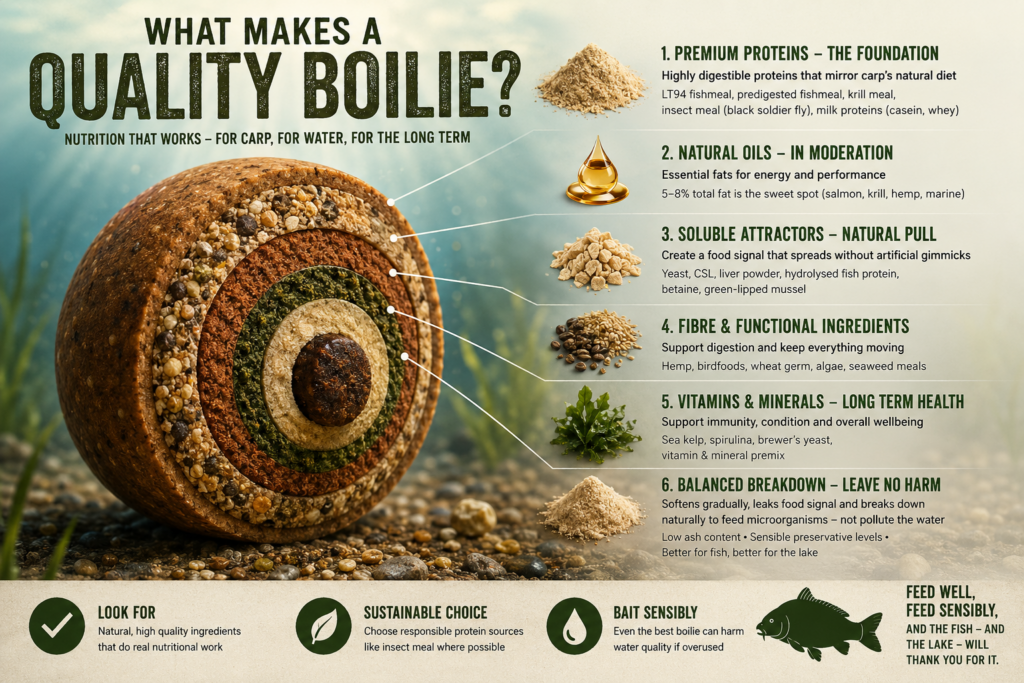
Protein quality comes first. Look for baits built around genuinely digestible proteins — LT94 or predigested fishmeal, krill meal, insect meal (black soldier fly is a strong shout), and milk proteins like casein and whey. Steer away from anything leaning heavily on cheap cereal fillers or excessive soya.
Oil should be moderate, not maximal. Around 5–8% total fat is the sweet spot for year-round digestion. Too much oil slows digestion in cold water, reduces oxygen exchange around bait that’s breaking down, and can leave oily films on the surface.
Soluble ingredients — yeast, CSL, liver powder, hydrolysed fish proteins, betaine, green-lipped mussel — do the job of attraction naturally, without relying on artificial stimulants layered on top.
Fibre matters too. Hemp, birdfoods, wheat germ, algae and seaweed meals help everything pass through the gut efficiently, rather than sitting heavy.
Vitamins and minerals — sea kelp, spirulina, brewer’s yeast, mineral premixes — support long-term immune function and overall condition, not just a single session’s catch rate.
A well-made boilie should also break down properly in water: softening gradually, leaking food signal, and eventually becoming food for microorganisms — not turning into an inert, slimy lump that sits on the bottom for days. Low ash content is a good proxy for protein quality here, and where preservative levels can be kept sensible (or bait is used frozen), so much the better.
None of this is an argument for expensive bait for its own sake. It’s about ingredients doing real nutritional work rather than masking with flavour, and about choosing sustainable protein sources — like insect meal — where you can.
And whatever bait you’re using, sensible baiting still matters most. Even the best boilie on the market can affect water quality if it goes in by the kilo rather than the handful — especially in weather like we’re having right now.
Feed well, feed sensibly, and the fish — and the lake — will thank you for it.